Custom Countertops Austin, TX
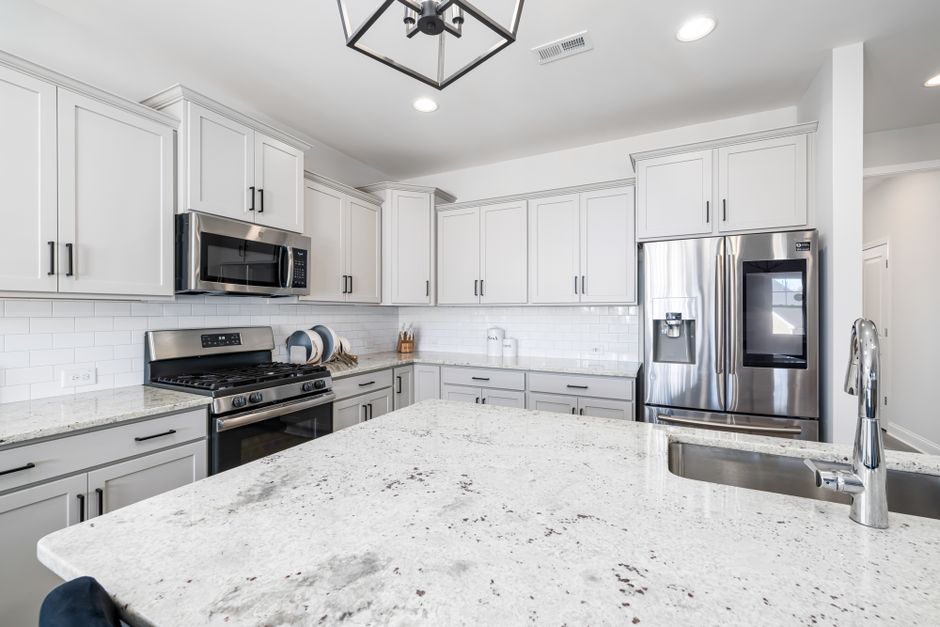
Notes from the fabrication shop on custom countertops in Austin, TX: templating, slab layout, seams, cutouts and edge profiles for local kitchens.
What We Cover
- Cutting Sink and Cooktop Openings in Stone How fabricators cut sink and cooktop openings, round the corners and support the thin spots so the stone does not crack.
- Edge Profiles and Polishing in the Shop How an edge profile is shaped and polished in steps with diamond pads, and how profile choice affects chipping and cleaning.
- Getting Heavy Slabs Into Older Austin Homes How installers carry long, heavy stone pieces through narrow doorways and tight yards in older Austin neighborhoods like Hyde Park and Travis Heights.
- How Countertop Templating Works in Austin Homes What happens during a countertop template visit in an Austin home, from cabinet checks to marking the sink and cooktop positions.
- Slab Layout and Vein Matching Before the First Cut How a shop lays out a slab on paper and on the table so veins run across seams and the pattern reads as one piece.
- Where Countertop Seams Go and How They Are Made Seam placement in L-shaped and long Austin kitchens, how edges are leveled, and how the joint is filled and clamped.
Custom Countertops Austin, TX
Custom countertops in Austin, TX start in the fabrication shop long before a slab reaches a kitchen. A fabricator reads the template from the house, studies the slab on a rack, and decides where each cut, seam and cutout will fall. The work is slow, dusty and wet, and most of it happens out of sight of the homeowner.
Templating and slab layout
Every top begins with a template, taken on a house that may sit on shrink-swell clay or on the limestone hills west of the Balcones Escarpment. The cabinets are checked for level, the walls are traced as they actually run, and the drawing goes back to the shop. There the template is moved around the slab until the veining in granite, quartzite or marble flows across the room and the seams fall where the pattern is quiet.
Cutouts, seams and edges
Sink and cooktop openings are cut with rounded corners so the stone does not crack from a sharp notch. Seams are placed away from those openings, joined with color-matched resin, and clamped flush. Edge profiles such as an eased edge, a bullnose or a waterfall edge are shaped with diamond wheels and then polished in steps, from coarse pads to a fine buff.
Moving stone into older homes
Bungalows in Hyde Park, Clarksville and Travis Heights have narrow doors, porch steps and shared driveways. Long pieces travel on edge on an A-frame cart, and in a tight house the top is cut in more sections so every piece can be carried. A hot Austin summer shortens the working day for the crew and speeds up how fast resin sets.
Guides
The pages here cover templating, slab layout and vein matching, sink and cooktop cutouts, seams, edge profiles and polishing, and the carry into older Austin homes. Each one describes the shop and install work as it is done, step by step.
Latest Guides

Getting an Austin Kitchen Ready for Countertop Installation Day
2026-10-06
Installation day is the shortest part of a countertop job and the least forgiving. By the time the crew backs a truck up to a house in Austin, the stone has been templated, laid out, cut, polished and wrapped, and the only things left to go wrong are the things in the kitchen itself. Most delays on site trace back to the room, not the slab. These questions come up before nearly every install, and the answers come from the shop and the carry, not from a brochure.
What has to be removed from the kitchen before the crew arrives?
Everything that sits on the old counters, and everything inside the cabinets directly below the sink and cooktop. Dishes, small appliances, the knife block, the soap, the toaster and the stack of mail all go somewhere else. The crew needs the whole surface bare and the floor in front of the cabinets clear, because a long piece of stone is carried flat across that floor at the last step and there is no room to step around a stool.
Under the sink needs the same treatment. The plumber, or the installer, has to reach the shutoff valves, the drain and the supply lines, and a cabinet full of cleaning products makes that slow. Old garbage disposals, water filters and dispensers tend to be the items that surprise people. Anything attached to the underside of the old top, or hanging from it, is part of the job and gets planned for before the first piece comes in.
Who disconnects the sink, cooktop and dishwasher?
The stone crew sets stone. Disconnecting and reconnecting plumbing, gas and electrical is usually a separate trade, and the line between the two should be settled at the template visit, not on the morning of the install. A drop-in range or cooktop on gas needs a licensed person to cap and restart the line. A dishwasher needs its supply and drain disconnected, and it often has to be pulled out so the new top can sit over the space.
In an older house near Zilker or Hyde Park, the shutoff valves under the sink may not have been turned in years and can seize or drip when they are finally moved. It is worth turning each one a few times the week before, so a stuck valve is found while the water can still stay on for the rest of the house.
Does the old countertop come off the same day?
In most cases the old top comes off the morning of the install, which means the kitchen is without a counter for several hours. Laminate tops are usually screwed up from below through the cabinet frames and glued along the back. Older stone tops can be heavy, bonded with construction adhesive, and sometimes cracked, so the removal is slower and needs two or three people. Tile counters are the messiest, with grout dust and a mortar bed that has to be chipped out before the cabinets are level again.
Taking out the old surface also reveals what the template could not show. A cabinet that was hidden under a thick edge can turn out to be lower than its neighbor. A wall behind a backsplash can be out of plumb. The crew checks level once the old top is gone and adjusts with shims before the new piece goes anywhere near the cabinets.
What condition do the cabinets need to be in?
The cabinets carry the stone, so they have to be square, level and fastened together. Face frames should be screwed to each other, and the base boxes should be screwed to the wall studs. A run that has pulled away from the wall, or a box that sags at one end, will pass the eye but fail under the weight of the new top, and the first sign is usually a seam that sits slightly proud of the surface.
Much of Austin sits on clay that swells in a wet spring and shrinks in a dry August, so a cabinet run can move a little from one season to the next. Houses east of the Balcones Fault, where the clay is deeper, tend to show this more than houses on the limestone to the west. A level that sits flat on a base cabinet in March can show a gap by the end of summer. Shimming handles most of it, and a run that is out by more than the thickness of the slab edge needs the cabinets adjusted first.
How wide does the path into the house have to be?
Wide enough for the longest piece, turned on its edge, with room on each side for the people carrying it. A top for a long wall can run eight or ten feet. It travels on edge, upright, on an A-frame cart or on the shoulders of the crew, and it has to clear door frames, light fixtures, stair rails and the corner of a hallway.
New homes in Mueller and other recent developments usually have wide doors, open plans and level driveways, and a long piece moves in a straight line. Older bungalows are the opposite, with narrow doors and porch steps, and the route is measured at the template visit so the shop can decide whether to cut the top in more pieces. A clear path is worth the effort the day before: move the patio furniture, pull back the entry rug, take the shoes off the stairs, and prop open any door that will be used more than once.
What happens to pets, children and the rest of the household?
They stay out of the way. A saw is not normally running in the kitchen, since cutting is done at the shop, but the crew does use a grinder, a polisher and water on site for small adjustments, and a piece of stone can drop or swing. A dog that wants to follow the crew through a propped door is one of the most common causes of delay. Cats slip out. Children underfoot make a heavy carry dangerous for everybody.
The simplest plan is a closed room or a day somewhere else for the animals, and a house with one door in use. Dust from the cleanup is fine and can be wiped away, but the slurry from wet polishing stains fabric and rugs, so anything soft near the kitchen is better moved away.
How long are the seams and edges worked on site?
A seam takes time because each side has to be leveled, the gap has to be filled with resin tinted to match, and the joint has to be clamped and left to firm up before it is shaved flush. Heat matters. Austin summers run long and hot, with highs of ninety degrees or more on more than one hundred twenty days a year, and resin sets faster in a warm room, which leaves less time to correct a joint. Many installers plan the seam work for early in the day, when the house is still cool.
Edge work is mostly done in the shop, but corners, returns and the seam ends are finished on site, with the same diamond pads used on the table. A waterfall edge on an island is the slowest piece, because the vertical leg has to be set, checked for plumb, and joined to the top at the miter without moving the pattern.
What should be checked before the crew leaves?
Run a hand along every seam and edge and feel for lips. Look across the top at a low angle, with a light held flat, so ripples and high spots show. Check that the sink and cooktop openings have an even reveal around them and that the faucet sits square in its holes. Open every drawer and door under the top to confirm nothing binds, because a thick edge can catch a drawer front that had clearance before.
It is also the right time to ask how the stone should be cleaned and when a sealer, if one is called for, goes on. Granite and quartzite usually take a sealer. Quartz and porcelain do not. Marble and soapstone behave differently from both, and the instructions depend on the stone, not on the shop. Photographs of any chips or flaws, taken before the crew leaves, make a later conversation simpler.
A good install day is a clear route, level cabinets, a bare surface and a plan for the plumbing, and the stone does the rest.

How Stone and Porcelain Countertops Behave on the Fabrication Table
2026-10-06
Every stone behaves differently on the fabrication table, and the differences show up months later in a kitchen. Some chip at a corner, some take a polish that holds, some stain at a seam, and some need to be lifted by more people than the kitchen has doors. This comparison goes through the common surfaces the way a shop handles them, from the saw to the finished edge, with the Austin conditions in mind: heat that lasts from May into October, rain spread through the year, and houses that move a little on clay.
How do the common surfaces compare in the shop?
| Surface | Cutting | Edge and polish | Seams | Handling |
|---|---|---|---|---|
| Granite | Cuts cleanly with diamond tooling, wears blades steadily | Takes a deep polish, holds a sharp profile | Joint shows least in busy patterns | Heavy, brittle across thin strips |
| Quartz | Cuts easily, resin can heat | Polishes evenly, profile edges are consistent | Visible on solid colors, hidden in flecked ones | Heavy, uniform, flexes little |
| Quartzite | Hard on tooling, slower to cut | Polishes bright, edges stay crisp | Pattern matching decides how it reads | Heavy, can have natural fissures |
| Marble | Cuts quickly, soft | Polishes easily, dulls quickly in use | Veins make matching important | Fragile at corners and thin sections |
| Soapstone | Cuts like hardwood | Honed, rarely polished | Joint visible, darkens with oil | Dense, soft, scratches in transit |
| Porcelain | Needs specific blades, chips if rushed | Edge is a cut face, often mitered | Narrow joints, pattern is printed | Thin and large, easy to snap |
The table is a starting point. Each slab within a surface type still varies, and a fabricator who has cut twenty kinds of granite will tell you no two behave the same.
Why does granite give the most predictable results?
Granite is an igneous rock built from interlocking crystals of quartz, feldspar and mica, and those crystals are hard and consistent. A diamond blade cuts it at a steady rate, and the edge polishes to a deep gloss with a few passes of pads. The grain of the stone is not directional, so a seam can be placed in nearly any spot without fighting a pattern.
Where granite surprises a fabricator is in the fissures. A line that looks like a vein in the slab can be a hairline crack that opens under stress, usually near a sink cutout. The shop checks for it by tapping the slab and listening, by spraying water on it to see where it soaks in, and by laying out the template so that the weakest-looking section ends up under a cabinet and not at a front strip.
What does quartz do differently on the table?
Quartz is an engineered product: ground stone bound with resin and pressed into a slab. That makes it uniform, so a layout is mostly about yield. A patterned slab with a repeating movement can be matched across a seam by lining up the repeat. A solid color slab is harder to hide a joint in, because there is no pattern to carry the eye past the line.
The resin changes how it is worked. Cutting with too much speed and too little water heats the edge and leaves a smeared, cloudy finish. Polishing needs the same care. Quartz also does not like prolonged heat on its surface, so the shop will mention trivets, and the cooktop cutout is made with a little more clearance than the maker's drawing asks for, if the maker allows.
Where does quartzite earn its reputation?
Quartzite is a metamorphic rock, formed when sandstone is heated and pressed until the grains fuse. It is harder than most granite, and the cut is slower and more tiring on blades. The payoff is an edge that stays crisp, a polish that does not dull and a look that often has the movement people associate with marble.
The same hardness makes a mistake expensive. A cutout cut a quarter of an inch off does not forgive, and a corner that chips during a carry is rarely patched without a visible mark. Fissures run through quartzite more often than through granite, so the template is laid out with extra care around the sink, and the slab is examined from both sides before it is committed.
How is marble handled, and what gives it trouble?
Marble is soft, which makes it quick to cut and quick to mark. A fabricator working marble keeps the table clean, because a grain of grit under a slab can scratch the polished face. Edges are shaped with lighter pressure, and the polish is finished with a fine pad so the face has depth. The look of marble is its veining, which is why the layout decides the job: where the dark vein enters and leaves each piece has to be planned across every seam.
In daily use marble dulls where acids touch it, and a busy kitchen will show rings and etching within weeks. Many homeowners accept that as part of the stone. Others choose it for a bathroom vanity, a baking station or a bar top, where the exposure is smaller. Marble also breaks at the thin front strip of a sink cutout more easily than the harder stones, so a brace stays in that strip until the top is set.
Why is soapstone a different kind of job?
Soapstone is rich in talc, which gives it a soft, dense feel. It cuts almost like hardwood, with a router or a carbide blade, and it can be shaped with files. It is not usually polished. A fabricator sands it to a matte finish and finishes with a mineral oil that darkens the stone and hides small marks.
The same softness is the risk during transport. Soapstone scratches from its own straps, from the cart and from the corner of the doorway. Crews wrap the edges and set the stone down on padded supports. A seam in soapstone shows a little, and the joint tends to darken with the rest of the surface as the oil takes.
What makes porcelain slabs tricky?
Porcelain slabs are large, thin and hard. They are fired at very high temperatures, and the pattern is printed on the face, so the edge is a plain cut that shows the body of the slab. Many shops cut a miter and fold the edge so the pattern wraps around. Cutting needs a blade made for the material and a slow feed, because the edge chips out if the blade is rushed.
The slab size is the other challenge. A large, thin sheet is difficult to carry, and it can snap across the middle if it is lifted flat. Installers stand it on edge and use suction cups. Cutouts for a sink need generous corner radii, since a tight corner is a crack waiting to happen, and the cooktop opening is supported underneath by a cabinet frame.
How does Austin weather enter the choice?
Austin has long hot summers, rain spread through the year and a freeze about once every two years. For an indoor countertop that mostly changes how the house moves. Cabinets on clay soil can shift slightly between a wet spring and a dry August, and a rigid top with a seam on a shifting cabinet will show it first at the seam. Stone with a little give in the pattern, such as a flecked granite or a veined quartzite, hides a hairline better than a solid, polished surface.
Outdoor kitchens near Lake Austin or Lake Travis are another matter. A top exposed to sun, rain and a hard freeze has to be a stone that does not absorb water and does not fade, and the fabricator needs a plan for drainage and expansion at the seam. Not every surface on the table above belongs outside.
Which surface suits which kitchen?
That depends on how the kitchen is used more than on how it looks. A household that cooks every night wants a hard, heat tolerant surface. A bar or a pantry can carry a softer stone. A long, narrow kitchen with a single seam in the middle is easier on the stone than an island with a waterfall edge and four pieces. The shop will ask about the cabinets, the route to the kitchen and the sink before it asks about color, since those decide what is workable.
Whatever the stone, the order of work is the same: template, layout, cut, polish, carry, set. The surface decides where the care goes within that order.